
Honey Filling Machine: Complete Automation Guide for Honey Manufacturers
Updated: Sep 22
Honey packaging involves more than simply dispensing a measured quantity into a bottle. For manufacturers handling growing production volumes, automation can connect container handling, cleaning, filling, capping and labeling into a coordinated packaging process.
A modern honey filling machine can form the central part of this system, while supporting equipment automates the operations before and after filling. The right level of automation depends on production volume, pack formats, existing machinery, available space and the desired production workflow.
Maharshi Udyog provides viscous and non viscous liquid filling equipment as well as integrated liquid filling lines. Its Servo Piston Filler and Viscous and Non Viscous Liquid Filling Line provide options for manufacturers looking to automate individual filling operations or develop a more integrated packaging setup.
What Does Honey Filling Automation Include?
Honey filling automation can cover several consecutive operations, beginning with empty bottle handling and ending with labeled finished containers.
A typical automated process can include:
Bottle unscrambling → Air jet cleaning → Honey filling → Capping → Labeling
Each stage performs a specific function. The bottle unscrambler supplies containers to the production line, the cleaning system prepares them for filling, the filler dispenses the product, the capping machine closes the containers and the labeling machine completes the primary packaging process.
This approach reduces the need to manually transfer containers between individual operations and allows the packaging stages to work as a coordinated production system.
How Does an Automated Honey Filling Process Work?
An automated honey filling machine operates as part of a sequence rather than as an isolated piece of equipment.
Step 1: Bottle Feeding
Empty bottles are supplied to the bottle unscrambler, which organizes them and transfers them onto the conveyor.
Step 2: Container Cleaning
Suitable bottles can pass through an air jet cleaning stage before reaching the filling station.
Step 3: Honey Filling
The containers are positioned below the filling nozzles, where the specified quantity of honey is dispensed.
Step 4: Capping
Filled containers move to the capping section, where suitable closures are applied and tightened.
Step 5: Labeling
The capped containers proceed to the labeling station for application of the required labels.
Step 6: Finished Product Handling
After labeling, the finished bottles can move to the next stage of handling, inspection, secondary packaging or dispatch.
Automating these steps creates a continuous flow and reduces unnecessary manual movement throughout the packaging operation.
How Does an Automatic Honey Filling Machine Improve Production Workflow?
An automatic honey filling machine can reduce the amount of manual intervention required during repetitive packaging operations.
Automation can help manufacturers establish a more consistent workflow by coordinating:
Bottle movement
Filling cycles
Product dispensing
Container transfer
Capping
Labeling
Instead of manually placing each bottle under a filling nozzle and transferring it to another packaging station, containers can move continuously through the connected equipment.
This can be particularly useful for manufacturers handling larger production volumes or multiple packaging operations in sequence.

How Is Bottle Handling Automated Before Honey Filling?
Bottle handling is an important part of an automated honey bottle filling machine setup.
Before containers reach the filler, they need to be supplied in a consistent orientation and at an appropriate rate. An automatic bottle unscrambler can organize randomly supplied bottles and place them onto the conveyor.
Automated bottle handling can provide:
Continuous container supply
Consistent bottle orientation
Reduced manual loading
Better synchronization with the filling machine
More orderly movement through the packaging line
The bottle handling equipment should be matched with the container's shape, size and production speed to maintain a stable flow into the filling station.
Why Is Container Cleaning Important Before Honey Filling?
Container preparation is another stage that can be automated before filling.
An air jet cleaning machine can be positioned before the filling station to help remove loose particles from suitable containers. This provides a dedicated cleaning stage within the packaging sequence rather than requiring operators to manually prepare each bottle.
For an automated system, the cleaning equipment must be synchronized with bottle movement so that containers reach the filling station in the intended sequence.
Maharshi's Viscous and Non Viscous Liquid Filling Line includes an automatic air jet cleaning machine as part of its integrated packaging arrangement.
How Does a Servo Piston Honey Filler Fit into an Automated Line?
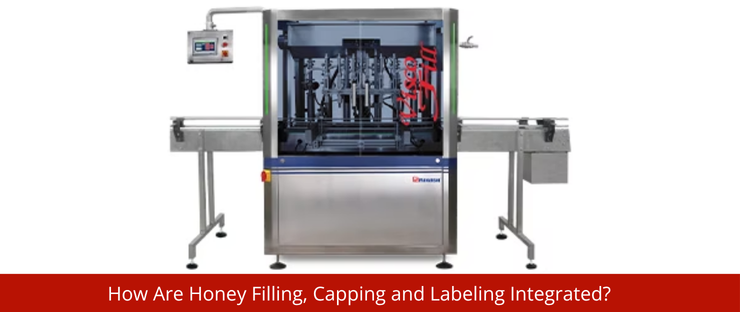
Maharshi Udyog's Servo Piston Filler for Viscous and Non Viscous Liquid Filling is designed to provide controlled filling for liquid applications.
The machine uses servo driven piston movement, PLC based controls and touchscreen HMI operation. It is available in 4, 6, 8, 10 and 12 filling head configurations, allowing the equipment to be configured for different production requirements.
The published specification provides a filling range of 10 gm to 5 kg and an approximate speed of 30 to 120 bottles per minute, depending on the application and configuration.
Other listed features include:
SS 316 piston cylinders
Teflon piston rings
Pneumatic filling nozzles and valves
Drip free filling arrangement
CIP ready configuration
Overhead product tank
Product level sensors
Stirrer and jacket arrangement
For honey manufacturers, the final configuration should be established according to the actual product, pack size, container and production requirements.
How Many Filling Heads Does an Automated Honey Filler Need?
The number of filling heads is primarily a production capacity consideration.
Maharshi's filler can be configured with 4, 6, 8, 10 or 12 filling heads. A manufacturer requiring a particular output can therefore select an appropriate configuration rather than treating every production requirement as identical.
The decision should consider:
Required bottles per minute
Filling quantity
Number of production shifts
Available production time
Future capacity requirements
Space available for the equipment
A higher number of filling heads can support greater output, but the appropriate configuration should be based on actual production requirements and application trials.
How Does PLC and HMI Control Work in an Automatic Honey Filling Machine?
Modern packaging automation depends on coordinated machine controls.
Maharshi's filling equipment incorporates PLC control and touchscreen HMI operation. The PLC manages machine functions and sequences, while the HMI provides an interface through which operators can interact with the equipment and manage relevant settings.
Depending on the machine configuration, the control system can coordinate functions such as:
Filling cycle operation
Conveyor movement
Machine start and stop
Filling parameters
Sensor inputs
Product level monitoring
Machine status
Centralized controls can make an automated filling system easier to operate than a collection of disconnected manual stations.
How Are Filling, Capping and Labeling Synchronized?
Filling is only one stage of finished bottle production. Once honey has been dispensed, the container needs to move efficiently to capping and labeling.
The basic sequence is:
Filling → Container transfer → Capping → Labeling
Conveyors provide the physical connection between the machines, while sensors and machine controls help maintain the required sequence.
Synchronization is important because a disruption at one stage can affect subsequent operations. For example, inconsistent bottle flow can reduce the effective output of the filling or labeling section even when individual machines have higher rated capacities.
An integrated packaging line therefore needs to be evaluated as a complete workflow rather than by looking at the speed of one machine alone.
What Are the Advantages of Automating Honey Bottle Filling and Packaging?
Automation can provide benefits across several operational areas.
Consistent Production Cycles
Automated machines can perform repetitive packaging operations according to programmed parameters.
Reduced Manual Handling
Bottle feeding, filling and downstream operations can be automated, reducing repetitive operator involvement.
Coordinated Packaging
Connected machines can maintain a continuous sequence from bottle feeding through labeling.
Scalable Production
Multi head filling configurations and additional automated equipment can support different production requirements.
Better Process Organization
An integrated line provides a defined movement path for containers and reduces unnecessary movement between separate workstations.
The actual productivity and operational benefits depend on machine configuration, product characteristics, container format and production conditions.
How Can Manufacturers Manage Different Honey Pack Sizes on an Automated Line?
Manufacturers often need to package products in more than one filling quantity. When multiple SKUs are handled on the same production system, changeover requirements become an important consideration.
Manufacturers should define:
Filling quantities
Bottle dimensions
Bottle neck specifications
Closure dimensions
Label dimensions
Required changeover frequency
Machine settings and mechanical adjustments may need to be changed when moving between substantially different container formats or filling quantities.
Planning these requirements during machine selection can help manufacturers avoid unexpected production interruptions later.
What Should Honey Manufacturers Consider Before Automating Their Filling Line?
Before investing in an automated honey packaging machine, manufacturers should establish a clear production profile.
Production Requirement
Determine current production volume and the desired future output.
Packaging Formats
Identify the bottle sizes, materials and pack quantities that the line will handle.
Existing Equipment
Check whether existing capping, labeling or conveyor equipment can be integrated into the proposed system.
Automation Scope
Determine whether automation is required only for filling or for the complete packaging sequence.
Production Space
The available floor area can influence machine arrangement and conveyor configuration.
Future Expansion
Consider whether the selected setup should accommodate increased output or additional packaging formats in the future.
Application Testing
Actual product and container samples can be used to validate the proposed configuration before finalizing the equipment.
These details help a machinery manufacturer develop a configuration based on the real production environment rather than a generic machine specification.
Standalone Honey Filler vs Integrated Honey Packaging Automation
Not every manufacturer needs a complete automated line from the beginning.
A standalone honey filler may be considered when filling is the main operation that needs automation and other packaging activities are already handled separately.
An integrated system becomes relevant when manufacturers want to connect several packaging stages.
Requirement | Possible configuration |
Filling only | Standalone honey filler |
Filling with automated bottle feeding | Filler with bottle handling |
Filling and capping | Integrated filling and capping |
Filling, capping and labeling | Automated packaging line |
End to end packaging | Complete liquid filling line |
This allows manufacturers to consider automation according to their present production needs while keeping future expansion in mind.
Why Choose Maharshi Udyog for Automated Honey Filling and Packaging?
Maharshi Udyog provides liquid filling machinery for viscous and non viscous applications along with integrated packaging line solutions.
Its Servo Piston Filler offers multiple filling head configurations, PLC and HMI based operation, an adjustable filling range and features designed for automated liquid filling applications.
For manufacturers looking for broader automation, Maharshi's Viscous and Non Viscous Liquid Filling Line combines bottle unscrambling, air jet cleaning, servo piston filling, rotary screw capping and double side labeling into a coordinated packaging arrangement.
This provides manufacturers with the option to automate an individual filling operation or evaluate a more comprehensive packaging workflow according to their production requirements.
Conclusion
A modern automatic honey filling machine can do more than dispense honey into bottles. When connected with bottle handling, container cleaning, capping and labeling equipment, it becomes part of an automated packaging workflow designed to reduce manual intervention and maintain a continuous production sequence.
For manufacturers with different production requirements, automation can be implemented at different levels. A standalone honey bottle filling machine can address the filling stage, while an integrated honey filling line can automate multiple operations from empty bottle feeding to labeled finished containers.
Maharshi Udyog's Servo Piston Filler and Viscous and Non Viscous Liquid Filling Line provide configurable solutions for automated liquid packaging applications. The appropriate setup should be determined from actual production volume, pack formats, container specifications, required automation and application testing.
For honey manufacturers planning automation, defining the complete packaging workflow before selecting individual machines can help create a more efficient and scalable production system.