
Automatic Ghee Filling Machine: A Complete Guide for Ghee Manufacturers
Updated: Sep 9
Ghee is a widely consumed dairy-based fat used in households, food processing, restaurants and commercial kitchens. As ghee manufacturers expand production and move toward modern retail packaging, accurate and hygienic filling becomes increasingly important. Manual filling can make it difficult to maintain consistent fill quantities, production speed and packaging uniformity, particularly when handling larger production volumes.
An automatic ghee filling machine can automate the filling process and provide controlled, repeatable dosing into bottles, jars and other suitable containers. For manufacturers looking beyond filling alone, an integrated ghee packing machine can combine container handling, filling, capping and labeling into a continuous packaging process.
Maharshi Udyog offers a Servo Piston Filler for Viscous & Non-Viscous Liquid Filling, along with an integrated viscous/non-viscous liquid filling line. The filling technology is designed for applications involving products such as edible oils and dairy products, making it relevant for evaluating ghee filling applications.
Why Use an Automatic Ghee Filling Machine?
Automation can improve the consistency and efficiency of ghee packaging while reducing dependence on manual operations.
Key advantages include:
Consistent filling: Automated dosing helps maintain uniform quantities across containers.
Higher production efficiency: Multi-head filling configurations can support higher output than manual filling.
Reduced manual intervention: Container positioning and filling can be integrated into an automated process.
Better process control: PLC and HMI-based controls allow operators to manage machine settings and production parameters.
Reduced product spillage: Properly configured filling nozzles can help minimize dripping during filling.
Scalability: Filling equipment can be selected according to current production requirements and future capacity needs.
The appropriate machine configuration depends on factors such as ghee characteristics, filling quantity, container format, production speed and the required level of automation.
How Does a Ghee Filling Machine Work?
An automatic ghee filling machine generally follows a controlled sequence to deliver a predetermined quantity of product into each container.
Container Infeed
Empty jars or bottles are transferred to the filling area through a conveyor system. In a fully automated line, an automatic bottle unscrambler can orient containers and feed them onto the production conveyor.
Maharshi's automatic bottle unscrambler is designed for PET and HDPE bottles of different shapes and sizes, with quick-change capabilities for different container formats. The company states an operating speed of up to 250 bottles per minute, depending on container size and shape.
Container Cleaning
Before filling, containers can pass through an air-jet cleaning stage. Maharshi's automatic air-jet cleaning machine uses diving-type nozzles and air-vacuum arrangements to clean the inner areas of containers.
The system can handle glass, plastic, PET, HDPE, LDPE bottles, jars and other suitable containers.
Product Filling
The containers are positioned beneath the filling nozzles, where the filling system delivers the required quantity of ghee.
A piston-based filling system is particularly relevant when controlled dosing is required for products with higher viscosity. Maharshi's servo piston filler uses electrically driven pistons powered by ball screws, with PLC control and servo synchronization.
Filling Completion
After the required quantity is dispensed, the filling nozzles retract and the filled containers move forward to the next stage.
Maharshi's filler incorporates pneumatic nozzles and valves designed for drip-free filling, helping maintain cleaner filling operations.

What Makes a Servo Piston Filler Relevant to Ghee Filling?
The filling technology selected for ghee should match the product's physical characteristics and the required filling accuracy.
Maharshi's Servo Piston Filler for Viscous & Non-Viscous Liquid Filling uses servo-driven piston technology for controlled filling. The system is PLC-controlled and provides touch-screen HMI operation for filling-volume adjustments.
Important features include:
Servo-Driven Piston Filling
Electrically driven pistons provide controlled product displacement during each filling cycle. This makes the technology suitable for applications where repeatable dosing is important.
Multi-Head Configuration
Maharshi offers configurations with 4, 6, 8, 10 or 12 filling heads, allowing manufacturers to select a configuration according to their required production output.
Adjustable Filling Range
The published specification for the servo piston filler provides an adjustable filling range of 10 g to 5 kg, using SS 316 piston cylinders with Teflon rings. The appropriate range and configuration should be established according to the actual ghee product and target pack size.
CIP-Ready Design
The filler is described as CIP (Clean-In-Place) ready, supporting easier cleaning operations where the machine configuration and production process require it.
Overhead Product Tank
The filling system includes an overhead storage tank with sensors, a stirrer and jackets for automated liquid-level control. Product-handling requirements should be evaluated specifically for the ghee formulation and operating conditions.
Ghee Jar Filling Machine for Different Container Formats
A ghee jar filling machine needs to accommodate the container format used by the manufacturer. Ghee may be marketed in different pack sizes and container materials depending on the target market and product positioning.
Important considerations include:
Jar or bottle material
Container diameter and height
Filling volume
Container shape
Neck configuration
Cap type
Required production speed
Changeover requirements
Maharshi's servo piston filler is designed for PET, HDPE and glass bottles/containers, while its air-jet cleaning and labeling equipment can also accommodate different container formats.
The exact machine configuration should be finalized after reviewing the actual container samples, product characteristics and production requirements.
What Are the Important Specifications of a Ghee Filling Machine?
Manufacturers should compare machines based on application requirements rather than looking at speed alone.
Filling Range
The machine should cover the required pack sizes without compromising filling accuracy.
Number of Filling Heads
More filling heads can increase output by allowing multiple containers to be filled during each cycle. Maharshi offers 4- to 12-head configurations for its servo piston filler.
Production Speed
Maharshi specifies a filling speed of approximately 30 to 120 bottles per minute, depending on the machine configuration and application. Actual output should be confirmed for the selected ghee formulation, container and filling quantity.
Filling Accuracy
Consistent dosing is particularly important for packaged food products because variations in fill quantity can affect product yield, consumer expectations and regulatory compliance.
Product Compatibility
The filler should be evaluated against the ghee's viscosity, formulation and operating conditions. Product trials are recommended before finalizing the equipment.
Cleaning Requirements
For food applications, machine design should support appropriate cleaning and sanitation procedures. A CIP-ready configuration can be advantageous where applicable.
From Ghee Filling to Complete Ghee Packing
Filling is only one stage of the packaging process. A complete ghee packing machine solution may incorporate several operations to move empty containers through to finished, labeled packs.
A typical automated line can include:
Bottle unscrambling → Bottle cleaning → Ghee filling → Capping → Labeling → Finished-product handling
Maharshi's Viscous & Non-Viscous Liquid Filling Line combines multiple packaging stages, including a high-speed automatic bottle unscrambler, automatic air-jet cleaning machine, servo piston filler, rotary screw capping machine and double-side labeling machine.
This type of integrated approach can reduce the need for separate manual handling between individual packaging operations.
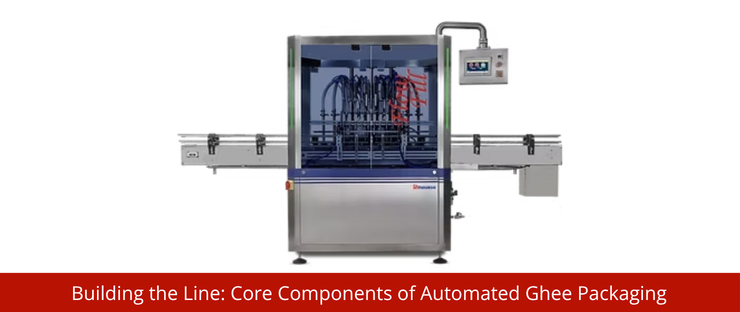
Components of an Automated Ghee Packaging Line
Automatic Bottle Unscrambler
The bottle unscrambler automatically receives containers, orients them upright and transfers them onto the production conveyor. Maharshi states that its system can store approximately 2,500 bottles, depending on bottle size and shape, helping support continuous production.
Air-Jet Bottle Cleaning
The air-jet cleaning machine uses high-pressure air through diving nozzles to clean the inside of containers before filling. An optional ionizer arrangement is also available for enhanced cleaning.
Servo Piston Filler
This is the core filling stage where the required quantity of product is dosed into each container. Its multi-head configuration and servo-driven piston system are designed for controlled, high-speed filling.
Rotary Screw Capping Machine
After filling, containers can be automatically capped using a rotary screw capping system. Maharshi offers 4-, 6-, 8- and 10-head configurations, with published speeds of approximately 60 to 150 bottles per minute depending on the application.
Double-Side Labeling Machine
Front-and-back labeling can be integrated after capping. Maharshi's double-side labeling machine is designed for bottles, containers and jars and can be configured for different shapes and label-placement requirements.
Benefits of an Integrated Ghee Packing Machine
An integrated packaging line can provide advantages beyond those offered by a standalone filler.
Continuous Material Flow
Containers move from one operation to the next with less manual transfer.
Consistent Packaging
Filling, capping and labeling are performed through controlled machine processes.
Reduced Handling
Automated container movement reduces repeated manual handling between packaging stages.
Better Production Planning
A line can be configured around the desired production rate, container format and packaging sequence.
Easier Expansion
Manufacturers can evaluate individual machines or a more complete line depending on their present production requirements and future expansion plans.
How to Choose the Right Ghee Filling and Packing Solution
Before purchasing a ghee filling machine, manufacturers should define the application rather than selecting equipment solely on its advertised speed.
Consider the following:
Product characteristics: Evaluate the ghee formulation and its filling behavior.
Pack sizes: Define the required filling quantities.
Container type: Confirm whether the application uses glass, PET, HDPE or another suitable format.
Production volume: Establish the required bottles or jars per minute.
Automation level: Decide whether a standalone filler or complete packaging line is appropriate.
Capping requirements: Identify the closure type and required capping speed.
Labeling requirements: Determine whether front, back or wrap-around labeling is needed.
Cleaning requirements: Consider the sanitation process and cleaning frequency.
Future capacity: Account for expected production growth.
Integration: Confirm that filling, capping, labeling and conveyor systems can operate as a coordinated line.
Ghee Packing Machine Price: What Determines the Cost?
The ghee packing machine price cannot be determined from the product name alone. The final investment depends on the machine configuration and the number of packaging operations that need to be automated.
Major cost factors include:
Filling technology
Number of filling heads
Required production speed
Filling range
Container type and dimensions
Bottle unscrambling requirements
Cleaning system
Capping technology
Labeling system
Conveyor configuration
PLC/HMI and automation requirements
Customized machine features
Complete-line integration
A standalone ghee filling machine will generally have a different configuration and investment level from a complete packaging line incorporating bottle handling, cleaning, filling, capping and labeling.
Therefore, manufacturers should compare quotations based on machine configuration, output, automation level and included equipment, rather than comparing price alone.
How to Select a Ghee Packing Machine Manufacturer
Choosing the right ghee packing machine manufacturer is as important as selecting the filling technology.
A suitable machinery partner should be able to understand:
Product characteristics
Required filling quantities
Container formats
Desired production capacity
Automation requirements
Packaging-line integration
Cleaning and maintenance needs
Future production expansion
It is also useful to evaluate the manufacturer's ability to supply multiple stages of the packaging process. A supplier capable of integrating filling, capping, labeling and container handling can simplify project coordination and line integration.
Why Consider Maharshi Udyog for Ghee Filling and Packaging?
Maharshi Udyog provides liquid filling and packaging equipment covering both individual machines and integrated packaging-line configurations.
Its Servo Piston Filler for Viscous & Non-Viscous Liquid Filling is designed for PET, HDPE and glass containers and uses PLC-controlled servo piston technology. The machine offers 4 to 12 filling heads, a published filling range of 10 g to 5 kg and speeds of approximately 30 to 120 bottles per minute, depending on the application and configuration.
For manufacturers seeking broader automation, Maharshi's Viscous & Non-Viscous Liquid Filling Line combines container unscrambling, air-jet cleaning, filling, rotary screw capping and double-side labeling in an integrated packaging sequence.
For a ghee application, the final equipment configuration should be selected after reviewing the product, container, filling quantity, operating conditions and required production rate.